
What Happens When a Health System Rethinks Access to Care?
Jamie Scott
November 23, 2026
Healthcare costs keep climbing. Access to primary care continues to be a challenge. And employers are looking for ways to give their people better healthcare without simply adding another benefit or another expense.
These aren't new challenges. But they do raise an important question: What if we approached them differently?
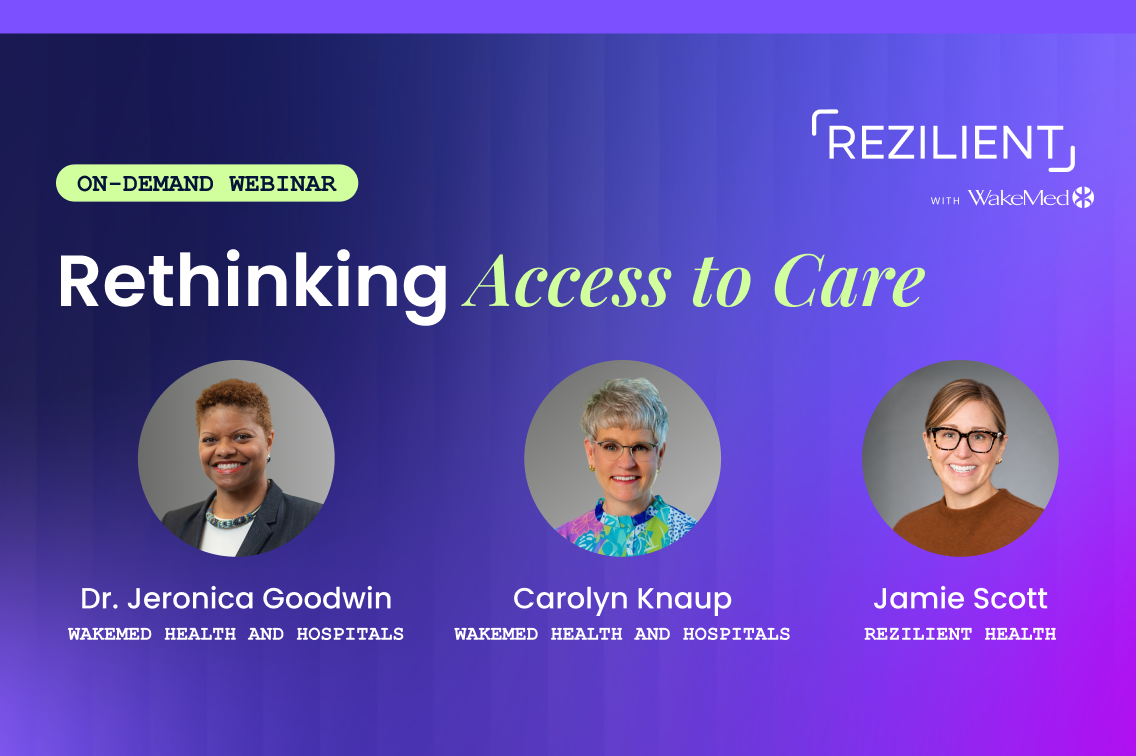
I recently had the opportunity to sit down with two leaders from WakeMed Health & Hospitals, Dr. Jeronica Goodwin, Senior Vice President of Human Resources and Chief People Officer, and Carolyn Knaup, Senior Vice President of Strategic Ventures and Ambulatory Operations.
We talked about why WakeMed partnered with Rezilient, what they're learning from the experience, and what this type of partnership could mean for other employers across North Carolina.
What I appreciated most about the conversation was hearing two different perspectives on the same challenge. Jeronica looks at healthcare through the lens of an employer responsible for the health and well-being of its employees and their families. Carolyn looks at it through the lens of a health system working to expand access, maintain quality, and better connect patients to care.
Both perspectives are important. And together, they tell a much bigger story.
Rezilient with WakeMed is about more than expanding primary care access. It's about connecting that care to WakeMed's specialty and hospital services, while giving employers an opportunity to access competitive pricing through direct contracting.
That combination creates a different approach to how healthcare is delivered, coordinated, and paid for.
More access doesn't always mean more buildings
One of the things Carolyn talked about was the challenge of expanding access through traditional healthcare infrastructure alone.
As she put it:
“You can't build enough bricks and mortar in the traditional manner in order to give people enough access to primary care.”
It's a reality many health systems are facing. Building more clinics takes time, capital, and clinical resources. And even with more physical locations, care isn't necessarily available when or where patients need it.
Through Rezilient with WakeMed, we're taking a different approach.
Our CloudClinic model combines an in-person clinical team member with a provider who joins virtually. Connected diagnostic technology allows that provider to conduct a physical exam, while the on-site team supports the patient throughout the visit.
The model also connects patients to urgent care, specialty consults, and ongoing care navigation.
For WakeMed, that means expanding primary care access without requiring a provider to be physically stationed at every location.
Carolyn described the partnership as another way to meet people where they are, while keeping their care connected to the broader WakeMed system.
And that's an important distinction. This isn't about replacing existing providers or services. It's about extending their reach.
WakeMed is an employer, too
One of the more interesting parts of our conversation was hearing Jeronica talk about the partnership from an employer's perspective.
WakeMed isn't just our health system partner. It's also a self-insured employer offering Rezilient to its own employees and eligible dependents.
When I asked Jeronica what gaps she was hoping to address, her answer was straightforward.
“The two gaps that I was looking to address, and Rezilient has helped us with that. Number one is access.”
She talked about making care available in the communities where employees live, giving families more choices, and creating additional opportunities to receive care within WakeMed's network.
But access isn't just about getting an appointment.
It's also about what happens during and after that appointment.
Jeronica shared that employees are noticing the difference in how quickly they can see a provider and how much time they get during their visits.
“Although you get more time with your provider, you don't have to wait to see that provider.”
That's a pretty meaningful combination, especially for employees trying to fit healthcare into already busy lives.
The appointment is only part of the experience
Getting someone into primary care is important. Helping them navigate what comes next, whether a specialist, additional testing, or follow-up care, is just as important.
Jeronica described that support as one of Rezilient's greatest contributions to the partnership: “I think one of the greatest values that Rezilient does deliver is that care navigation and helping stay with that patient and guide them along the way.”
Through Rezilient with WakeMed, primary care and care navigation connect patients with WakeMed's specialty and hospital services when needed. Rezilient with WakeMed brings those services together to support patients beyond the first visit.
Carolyn called Rezilient the “quarterback” for coordinated care. I like that analogy: primary care should be the front door to healthcare, with someone helping patients through it and staying involved afterward.
What are employees actually experiencing?
A care model has to work for the people using it. Carolyn shared that WakeMed employees had made nearly 1,000 repeat visits during approximately the first 10 months of the partnership, along with strong patient satisfaction.
Her explanation stuck with me: “People go back to where they feel like they're being heard and they're being listened to and they're receiving care that's meaningful.”
That is the experience we want to create: time to ask questions, understand options, and build relationships with trusted providers. Consistently delivering that experience gives patients a reason to return.
Connecting better care with better cost management
We couldn't have a conversation about employer healthcare without talking about cost.
For self-insured employers, improving care and managing costs are closely connected. Jeronica emphasized investing in employees' health and preventive care, a principle central to our approach.
The partnership gives employers two ways to address healthcare spending. Rezilient with WakeMed combines primary care and navigation with preferred negotiated rates for eligible WakeMed services:
- Earlier, coordinated care: Easier access to primary care creates opportunities to identify health needs sooner and guide patients to appropriate treatment.
- Direct-contract pricing: Preferred rates for eligible specialty and hospital services offer a more immediate savings opportunity alongside the longer-term potential of prevention and coordination.
Employers can participate without replacing their existing health coverage, according to the partnership overview. The goal is to make care easier to access and healthcare spending easier to manage within the benefits employers already offer.
A partnership that complements existing providers
Some WakeMed primary care providers initially questioned how Rezilient would fit alongside their practices. Carolyn described how that perspective changed: “They originally thought it was competition, and now I think they see it as complementary.”
She also shared that WakeMed specialists have seen higher-quality referrals through the model. That is an important measure of the partnership: expanding access should support existing care teams and keep patients connected to the broader health system.
For employers, it means their employees have more ways to get care without losing the connection to a trusted local health system.
Where do we go from here?
I left the conversation thinking about how much opportunity exists when employers, health systems, and primary care partners work together instead of approaching these challenges separately.
WakeMed is already putting this model to work for its own employees. And through Rezilient with WakeMed, we're bringing that same approach to other employers across the Triangle.
For organizations looking at rising healthcare costs, the opportunity is worth exploring: better access to primary care, more coordinated specialty and hospital services, and a direct-contracting arrangement designed to create value for both employers and their employees.
We're still learning, measuring, and building on what's working. But the conversations we're having are encouraging, particularly as employers look for more practical ways to improve access and manage healthcare spending.
A big thank you to Jeronica and Carolyn for sharing their perspectives and being so open about WakeMed's experience.
If you're an employer or benefits advisor in North Carolina, I encourage you to watch the conversation. There's a lot worth exploring.
For speaker details and to share the recording with your team, visit the Rezilient with WakeMed webinar page.
Interested in learning how Rezilient with WakeMed could work for your organization?
Connect with our team to start the conversation.
One Connected Front Door to Care
Rezilient Health combines in-person care at local CloudClinics, virtual care, and coordinated care navigation into a single hybrid model — replacing a stack of disconnected point solutions. See how we partner with self-funded employers.